
Payment trends
Agentic Commerce: Why payments, consent, and trust will define the next era of customer experience
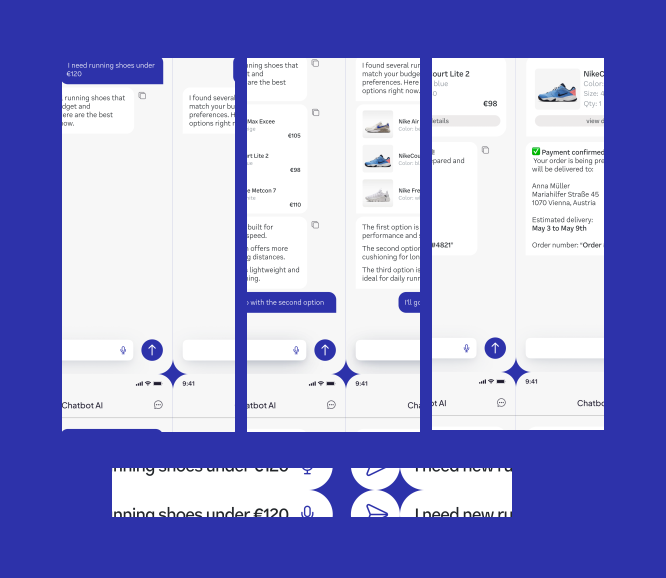
Agentic commerce is no longer theoretical. It is rapidly becoming a practical reality - one that will redefine how consumers discover products, how transactions happen, and how trust is established in a world driven by AI agents rather than human clicks. These questions were at the center of a recent Nexi Talks podcast discussion, where Nexi brought together experts from Google Cloud, the Agent Commerce Alliance, and Nexi’s own e-commerce leadership to explore what agentic commerce really means for merchants. While the technology is advancing quickly, one conclusion stood out clearly: the future of agentic commerce will be shaped not just by automation, but by how well payments, consent, and trust are designed into the experience.
From clicks to conversations - and now to delegation
For years, digital commerce has followed a familiar pattern. Consumers search, browse, compare, add to basket, and check out - click by click. Agentic commerce breaks this sequence. Instead of guiding users through interfaces, AI agents act on their behalf. They can anticipate needs, reason across options, and execute actions -sometimes completing purchases end to end with minimal human involvement. As discussed on the podcast:
Agentic commerce is about delegation. The consumer defines intent and boundaries, and the agent acts on their behalf, Raja Saggi, EVP e Commerce, Nexi.
For consumers, this promises convenience and speed. For merchants, it changes a more fundamental question: who is actually making the purchase?
Why agentic commerce is fundamentally different
AI recommendations and chatbots are not new. What is new is autonomy. Agentic systems can:
Carry intent across channels
Persist context over time
Act without step by step human input
That autonomy is powerful but it also introduces new risks. Merchants must be able to answer questions that didn’t exist in traditional e commerce:
Is this agent authorized to transact?
Can customer consent be proven?
Who carries liability if something goes wrong?
This is why agentic commerce is not just a UX shift—it is a trust shift.
The most complex part of the journey is the middle
Search and discovery are evolving rapidly, but their direction is relatively clear. Customer service is becoming conversational, predictable, and increasingly automated. The most complex- and least solved - part sits in between: the moment where intent turns into payment. This “middle” of the journey is where:
Verification must happen
Consent must be enforced
Risk and liability must be managed
In agentic commerce, payments are no longer the final step. They become the mechanism that confirms authorization, legitimacy, and accountability.
Open ecosystems vs closed platforms
During the discussion, a key tension emerged: the rise of tightly controlled, closed agentic environments versus open, interoperable ecosystems. Closed systems can move fast, but they risk concentrating power and limiting merchant control. Open systems, built on shared protocols, allow:
Merchants to retain ownership of customer relationships
Branded agents powered by merchant data
Transactions to happen across owned and non owned channels
For merchants of any size, interoperability is not a technical detail—it’s a strategic safeguard. It determines whether agentic commerce becomes a new form of dependency or a new source of differentiation.
Think in customer journeys, not technologies
One recurring theme from the conversation was the importance of starting with user journeys, not protocols. Agentic commerce works best when it is applied deliberately:
Where does automation genuinely reduce friction?
Which decisions can be delegated safely?
Where should humans remain in control?
Merchants that approach agentic commerce as a set of isolated tools risk fragmented experiences. Those that design end to end journeys build confidence faster—both internally and with their customers.
A pragmatic path forward: crawl, walk, run
Fully autonomous commerce will arrive - but most merchants don’t need to start there. A phased approach allows progress without overexposure to risk.
1. Crawl: make commerce conversational internally
Start by making data and operations conversational. Enable internal teams to query transactions, handle refunds, or resolve issues using secure AI interfaces - while keeping permissions tight and auditable.
2. Walk: introduce low risk payment actions.
Extend conversational capabilities to controlled actions such as pay by link or refund initiation. This builds confidence and surfaces security requirements early.
3. Run: enable agent driven transactions
Once consent models, verification, and auditability are proven, merchants can open up to agent initiated payments - whether through their own agents or trusted third party agents. This staged approach gives merchants room to learn, adapt, and stay firmly in control.
Trust becomes the product
In traditional e commerce, trust was largely implicit. In agentic commerce, it must be explicit and provable. The ecosystem is converging around key building blocks:
Intent mandates that define what an agent is allowed to do
Cryptographic proof that a customer approved a transaction
Agent verification (“know your agent”) to prevent fraud
Audit trails that protect both merchants and consumers
As noted during the conversation:
We are reintroducing agents into commerce - but this time with real autonomy. That makes verification, consent, and auditability non negotiable, Michael Pfeiffer, VP AI & Agent Commerce, Agent Commerce Alliance.
In this world, payment infrastructure becomes the neutral trust layer that enables innovation without sacrificing accountability.
The human remains essential
Despite increasing automation, one point was clear across the panel: humans stay in the loop. Successful agentic systems:
Allow merchants to define guardrails and thresholds
Support smooth handoff from agent to human when needed
Provide monitoring, quality metrics, and explainability
Agentic commerce is not about removing people from commerce—it’s about letting humans focus on judgment, oversight, and experience, while machines handle execution at scale.
What merchants should be doing now
Agentic commerce will not arrive everywhere at once. But merchants who wait for “full autonomy” before acting will miss the opportunity to shape how it works for them. Now is the time to:
Ensure your products and services are discoverable in conversational journeys
Lay foundations for consent, verification, and liability
Choose open, interoperable partners and platforms
Experiment safely within owned environments
Treat trust as a competitive advantage - not a compliance checkbox
Agentic commerce may feel effortless to consumers. For merchants, success will depend on the systems - and the trust - built behind the scenes. Payments are where intent becomes real. And in agentic commerce, trust is what makes that possible.
If you want to listen to the full conversation, find the podcast here.